
New research reveals AI challenges facing data teams

Simba helps builders embed trusted intelligence into every product, so they can deliver consistent, trusted answers in a world running on AI.

Ever since generative AI burst into global industries, independent software vendors (ISVs) and enterprises alike have been rushing to adopt it into their applications and workflows. But while AI helps accelerate processes, it comes with its fair share of challenges. Efficiency improvements from AI can come at the cost of valuable time and resources from development and engineering teams. Furthermore, data teams are aware of the risks that come with AI, such as hallucinations, security vulnerabilities, and data inaccuracy.
To better understand the mindset of data teams as they navigate AI-powered data and embedded analytics challenges, Simba recently partnered with Hanover Research to survey 325 data decision-makers in Canada, France, Germany, Ireland, South Africa, Switzerland, United Arab Emirates, United Kingdom, and the United States. Here, we discuss how data leaders use AI, the challenges they face, and how to overcome them.
Navigating uncertainty: the state of data and analytics in 2027
Learn moreDo data leaders even trust AI?
The past few years have been a rush for many industries to adopt AI. Now that data leaders have woven AI into their workflows, we asked how much trust data leaders put into it.
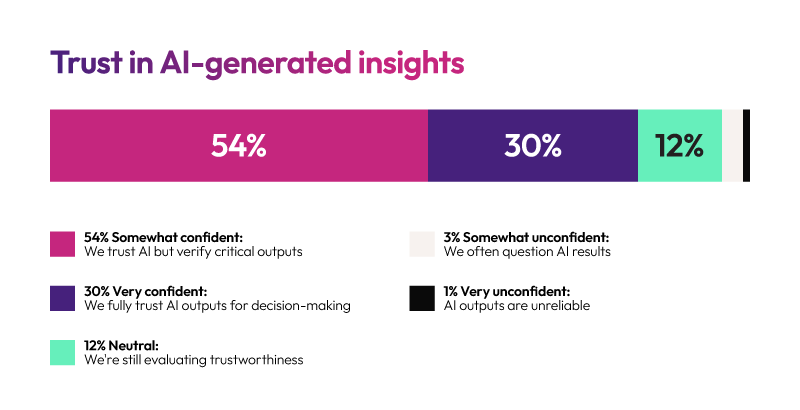
Our survey shows that 84% of data teams describe themselves as at least somewhat confident in AI. However, there’s a disconnect between expectation and reality when it comes to trusting AI answers. Although most are confident overall, only 30% fully rely on AI-generated outputs. 54% are cautious, trusting AI but verifying key findings before making decisions.
72% face barriers to trusting AI. Of these data leaders, here are the factors preventing them from trusting AI outputs:
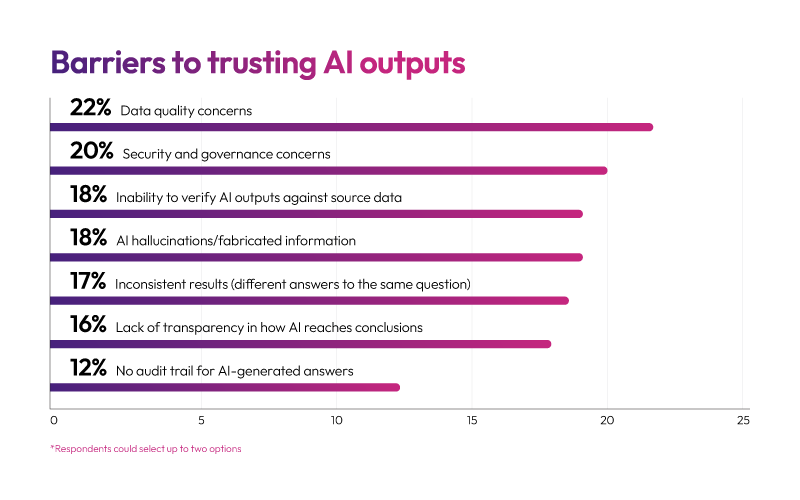
Overall, about half of those surveyed (43%) have experienced AI-related inaccuracies. Organizations can build trust in AI outputs by setting a foundation of governance, transparency, and compliance up front. The strongest drivers of AI trust are the ability to trace outputs to source data (38%), AI that understands business context (28%), and comprehensive audit trails (26%).
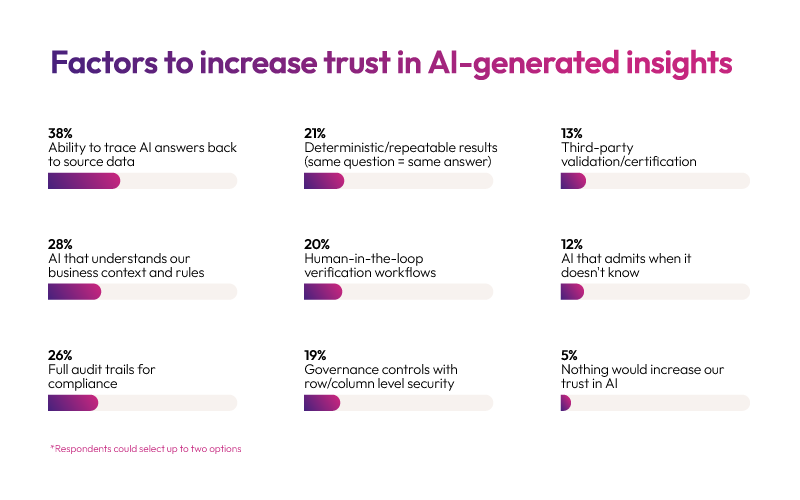
More than half of organizations (54%) trust but verify their AI outputs for good reason. As much as AI can provide insights and time savings, it can also pose data quality, accuracy, and security risks. Data leaders who want AI analytics they can trust should look for governed AI with audit trails to help verify information more easily and accurately. That way, teams can verify whether an answer is correct and rooted in the right data.
AI, privacy, and data security
This year, privacy is data leaders’ top concern. Depending on the industry and location, organizations contend with a variety of data privacy and technology laws. Complying with relevant laws is a requirement for all organizations, but protecting data privacy has an even bigger impact than compliance alone. Customers who invest in features like embedded analytics and AI put a significant amount of trust in their tools and solutions.
AI has increased risks for organizations. According to the 2026 Cost of a Data Breach Report by IBM and the Ponemon Institute, AI-driven attacks have increased by 51%. However, investment in AI and technology can help combat data breaches. Having protection in place at any level is crucial – the Cost of a Data Breach Report reveals among the 13% of organizations that reported data breaches related to AI applications, 97% lacked proper AI access controls.
Having security measures in place is vital for preventing threats, protecting organizations from hefty fines, and safeguarding customer trust and the organization's reputation.
In our study, we asked decision-makers which AI governance requirements they prioritize. Compliance with industry regulations led all other options at 75%. 100% of the organizations we surveyed have AI governance measures in place.
The data preparation time sink
AI is only as good as the information that’s fed into it. This is a key reason why 97% of data leaders identified data quality for AI success as the top trend in the next five years.
But preparing data for AI isn’t an easy task. Rising analytics expectations and increasing AI adoption are expanding operational complexity. Organizations are simultaneously supporting growing demands for advanced analytics capabilities while investing heavily in AI readiness.
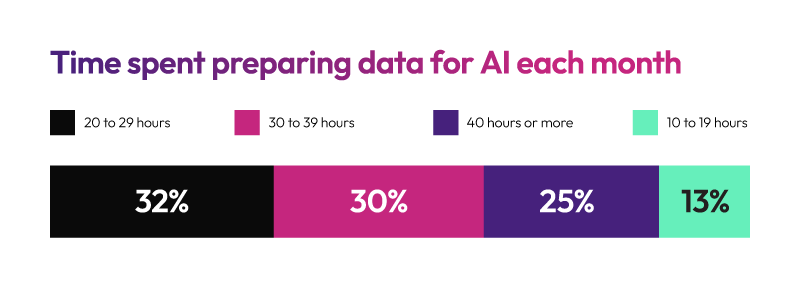
Preparing data for AI is a major time investment. The overwhelming majority of teams (86%) spend 20 hours or more preparing data for AI, and nearly a quarter (24%) spend 40 hours or more. This can create major operational burdens for data teams.
AI is also challenging for data teams to maintain. On a monthly basis, 64% spend between 10-29 hours on ad hoc requests.
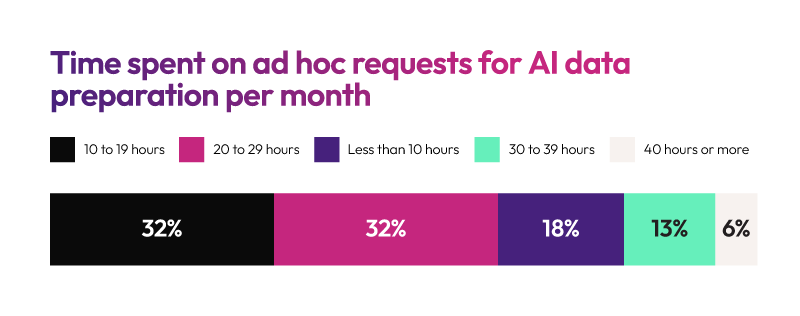
Preparing data for AI is time-consuming, as is ongoing management. This can cause data teams to struggle with bringing AI pilot projects to production.
When implementing and managing AI, data teams must balance efficiency with ensuring trust and accuracy. Data preparation, security, and risk of hallucinations are challenges facing nearly every organization. Teams that prioritize trustworthy analytics rise above AI roadblocks.
On its own, AI can access organizational data but might lack the business context required to answer a question correctly while introducing governance risks. A semantic layer creates meaning so that the AI can properly understand the intent of the question, while maintaining data governance.
Simba Agentic Intelligence helps reduce hallucinations by grounding answers in governed enterprise data. Its answers are tied to live data and show an information trail so that your users can easily track and verify and use to stand by results. While traditional BI tools surface dashboards and data integration tools move data, Simba Agentic Intelligence connects AI directly to governed enterprise data without copying or losing control.
Simba Agentic Intelligence is:
A trusted semantic layer. Does your AI query data through a governed semantic layer, or is it generating SQL directly against raw tables? The former approach is trustworthy.
Governance at the architecture level. Compliance and auditability shouldn’t be added after the fact. Organizations that build governance into their AI architecture now will have a durable advantage as AI regulations tighten.
Embedded, not bolted on. Analytics delivered inside existing workflows drives adoption. Standalone AI tools that require users to change how they work will see limited uptake.
Simba Agentic Intelligence is purpose-built for application teams that need an AI semantic layer fast without giving up flexibility or control. Simba products combine the best of BI, embedded analytics, and trusted intelligence so your insights are always delivered in context.
Ready to learn more? Read the full report to find out about the most pressing data and analytics trends today.