
AI Data Connectivity


Connect AI to Enterprise Data
Give models, agents, and AI apps governed access to live enterprise data through APIs, MCP integration, and an independent, unified semantic layer.
THE PROBLEM
AI Needs Governed Data Access
Connecting a model to a database is easy. Production access needs business context, permissions, and controlled query paths before AI touches enterprise systems.
Access Data Safely
Engineers can connect a model to a database, but production access is different. Agents need context, permissions, and controlled query paths before touching enterprise systems. Without that layer, every integration is a custom risk surface.
Share the Same Logic
AI assistants, internal apps, embedded workflows, and agent frameworks reach data in different ways. When each has its own definitions and permissions, the same question gives different answers. It gets worse as more AI tools arrive.
Skip Rebuilt Governance
Teams can spend months building authentication, permissions, metric logic, query validation, audit trails, and connectors before AI is production-ready. That work matters, but rarely differentiates. The fastest path is a governed layer to build on.
HOW IT WORKS
Give AI a Governed Data Path
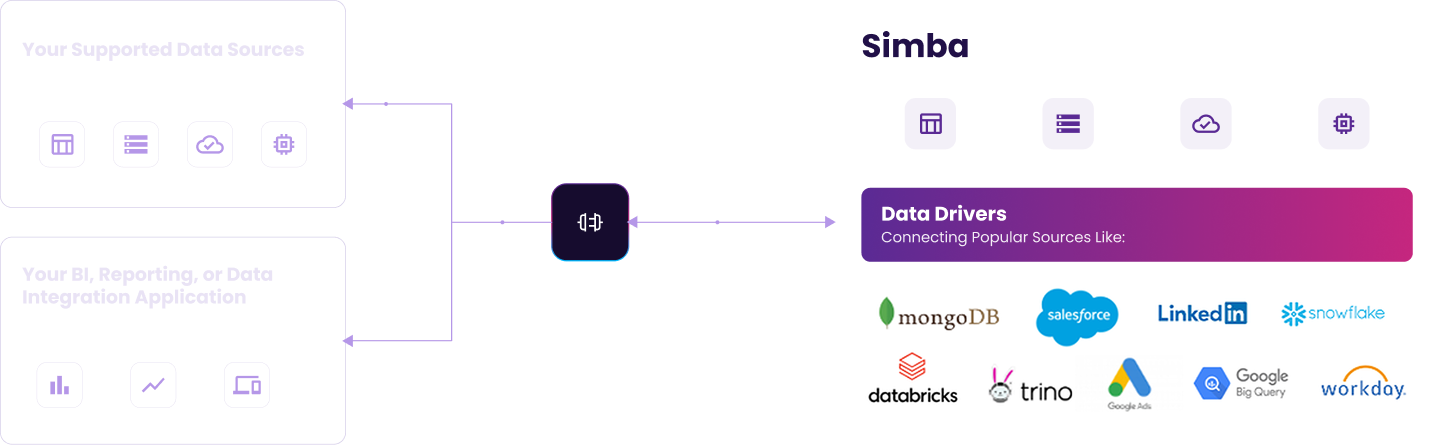
AI applications need more than a connection string. Simba Agentic Intelligence gives builders an independent, unified semantic layer that maps AI requests to approved business logic, permissions, and live data before a query runs.

API-Based Access
Connect AI applications and internal tools to governed enterprise data through controlled access patterns.
MCP Integration
Give supported AI tools and agents a governed way to discover, query, and use enterprise data.
Semantic Business Logic
Apply approved metrics, relationships, hierarchies, and domain rules before AI systems receive data.
Permission-Aware Queries
Enforce user, role, tenant, row, and column controls when AI systems request enterprise data.
Model Configuration
Configure model choices for data source and query workflows across Vertex AI, Azure OpenAI, and Bedrock.
Auditable Execution
Inspect query paths, source logic, and execution context so AI data access can be reviewed.
WHY US
AI Access Without Fragile Plumbing
Give AI engineers a governed layer to build against, one shared semantic path across many tools, and deployment you control including on-premises and hybrid.
Built for AI Engineers
Direct database access creates governance, security, and maintenance problems fast. Give engineers a governed layer so agents use data without bypassing controls.
One Layer for Many Tools
AI adoption rarely stops at one assistant. Give teams a shared semantic layer for models, agents, and workflows so each works from the same definitions and permissions.
Deployment You Control
AI data access should not force a cloud-only pattern. Support on-premises, private cloud, and hybrid, which matters for regulated teams needing infrastructure control.
Which AI Path Is Production-Ready?
Teams have several ways to connect AI to data. The difference is whether it only retrieves context or also applies governed definitions, permissions, and auditability.
| Feature | Simba Agentic Intelligence | Rag/Vector | Direct DB/MCP |
|---|---|---|---|
| Live structured data access | |||
| Approved metric definitions | |||
| Permission-aware queries | |||
| Governed SQL execution | |||
| API and MCP access | |||
| Model choice by workflow | |||
| On-premises or hybrid |
Frequently Asked Questions
Who is AI Data Access For?
AI engineers, data platform teams, application teams, and product builders connecting models, agents, or AI apps to enterprise data. These teams need more than database connectivity. They need governed access that respects definitions, permissions, and production controls.
What Does AI Data Access Mean?
Giving AI systems a controlled way to discover, query, and use enterprise data. The goal is not to expose raw databases directly to a model. The goal is to route AI requests through approved business logic, permissions, and live data access.
How Is This Different From Connecting an LLM Directly to a Database?
A direct connection may work for a prototype, but it does not solve governance, permissions, business definitions, auditability, or query control. Simba Agentic Intelligence sits between AI systems and data so requests are interpreted and governed. Production AI needs an access layer, not just a connection.
Does This Support Agents and MCP?
Yes. Simba Agentic Intelligence supports API and MCP access patterns for connecting AI tools, agents, and applications to governed data. Builders can expose data capabilities without handing every agent direct access to source systems. Agents use data without owning the access rules.
How Are Permissions Enforced?
Permissions should be applied before a query returns data to an AI system. Simba Agentic Intelligence can apply user, role, tenant, row, and column controls as part of the governed access path. AI data access should follow the same boundaries as the rest of the enterprise.
Can Multiple AI Tools Use the Same Data Logic?
Yes. The independent, unified semantic layer helps models, agents, applications, and assistants work from the same definitions and rules, reducing the risk of each tool interpreting key metrics differently. One governed layer makes AI adoption easier to scale.
Can We Choose Which LLM Is Used?
Yes. Simba Agentic Intelligence supports model configuration for the data source agent and query agent, so teams tune parts of the workflow separately. Current materials reference Google Vertex AI, Azure OpenAI, and AWS Bedrock. Balance speed, accuracy, reliability, and cost by workload.
Can This Run On-Premises or in a Private Environment?
Yes. Simba Agentic Intelligence is designed for on-premises, private cloud, and hybrid deployment, so teams align AI data access with residency, infrastructure, and policy requirements. A strong fit for regulated environments and any team avoiding a cloud-only AI dependency.
Does This Replace Our Existing Data Stack?
No. It gives AI systems governed access to data across the enterprise stack without replacing every warehouse, application, analytics layer, or integration. It creates a controlled access path for AI on top of the systems you already rely on.
What Should Teams Plan Before Connecting AI to Enterprise Data?
Start with the data domains AI should access, the metrics needing approved definitions, the permissions to enforce, and the environments where it must run. Then decide which tools or agents need access first. The best projects start with governance and builder experience together.