
Pros and Cons of Building Analytics vs. Buying Analytics

insightsoftware is the most comprehensive provider of solutions for the Office of the CFO. We turn information into insights, empowering business leaders to strategically drive their organization.
Application teams need to decide how to surface analytics to users. User engagement, experience quality, and user acquisition all depend on giving people useful data when they need it. Embedded analytics is one effective approach.
Research from the (2025 Embedded Analytics ROI Report) shows that 99% of organizations see ROI on their embedded analytics investment within 12 months, with 70% realizing returns in just 6 months. Embedded Analytics keeps data in the user's workflow context.
Instead of exporting to separate BI (business intelligence) tools, users query and visualize data without leaving your application. They work with live data in their familiar interface, which means faster decisions and less context switching. Application platforms without built-in analytics capabilities often lose ground to competitors offering integrated data exploration.
Whether you're building embedded analytics for the first time or enhancing existing capabilities, the key decision is whether to build internally or integrate a third-party solution. Each approach has distinct trade-offs in development time, resource allocation, and long-term maintenance.
The table below compares three approaches: building analytics capabilities from scratch, buying a Commercial Off-The-Shelf (COTS) product, or combining both strategies by partnering with a platform that lets you build unique IP while getting to market faster.
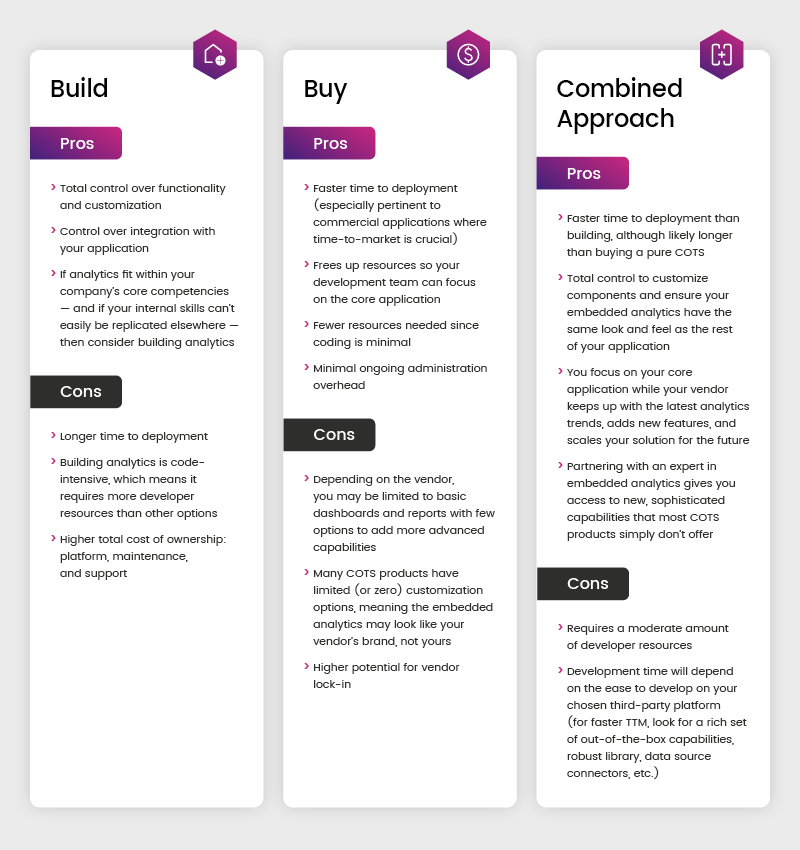
The build-versus-buy decision affects your entire development roadmap. Teams that combine both approaches can deliver sophisticated analytics capabilities faster than building from scratch, while investing development resources in features that differentiate their product rather than maintaining database connectors and query engines.
Data connectivity determines whether your embedded analytics actually work. ODBC and JDBC drivers handle connection protocols across data sources, reducing the integration work required. Your development team can focus on analytics features instead of building and maintaining individual database connectors for each system your users need to access.
The right approach depends on your application architecture, user requirements, and available development resources. Understanding these trade-offs helps you allocate resources where they create the most value for your users.
Logi Symphony from insightsoftware combines embedded analytics capabilities with enterprise-grade data connectivity. Connect to Simba’s full suite of data sources through ODBC/JDBC connectivity. See how the platform handles both the analytics layer and data connectivity challenges in one integrated solution. Book a demo today!