
MPP & Columnar Databases

insightsoftware is the most comprehensive provider of solutions for the Office of the CFO. We turn information into insights, empowering business leaders to strategically drive their organization.

Many SQL databases designed for large data volumes are built on column-store and massively parallel processing (MPP) architectures.
What is an MPP Database?
An MPP (Massively Parallel Processing) database is designed to handle large-scale data processing by using a distributed architecture. Unlike SQL Server, which is an example of a symmetric multiprocessing (SMP) system that relies on a single server with multiple processors sharing a common memory, MPP databases distribute the workload across many servers or nodes, each with its own memory and processors.
This parallel architecture allows MPP databases to scale out horizontally, providing high performance for complex queries on large datasets. Each server in an MPP system processes a portion of the data simultaneously, which significantly speeds up data retrieval and analysis tasks. As a result, MPP databases are ideal for big data applications and data warehouses where large volumes of data need to be processed quickly and efficiently.
In contrast, an SMP system like SQL Server is typically limited by the capacity of a single server, making it less suitable for very large-scale data operations. While SMP can efficiently handle moderate workloads, MPP offers superior scalability and performance by leveraging the power of multiple servers working in parallel.
MPP systems feature multiple servers
Most MPP databases leverage a “shared-nothing architecture” where each server operates independently and controls its disk and memory. They distribute data onto dedicated disk or solid-state drive (SSD) storage units connected to each server in the appliance. (A data warehouse appliance includes an integrated set of servers, storage, operating systems, and databases.) This allows them to resolve an SQL query by scanning data on each server in a parallel way. This divide-and-conquer approach scales linearly as new servers are added into the architecture and delivers high performance.
What is a Column-Oriented Database?
A column-oriented database (or columnar database) stores data by columns rather than by rows, which is how traditional relational databases operate. This design allows for highly efficient storage and retrieval of large datasets, particularly when querying a few columns across many rows.
In a column-oriented database, all the values of a single column are stored together, which enables faster read performance for analytical queries that need to access only specific columns. This architecture is particularly well-suited for data warehousing and analytics workloads, where operations like aggregations, filtering, and scanning of large datasets are common. Additionally, columnar storage formats often achieve better data compression, further enhancing performance and reducing storage costs.
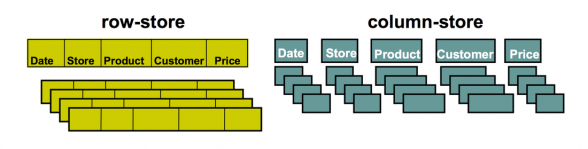
For querying large data sets column-store databases are more efficient than row-store.
Traditional relational database management software systems designed for transaction processing store data by row, as this provides most efficient operation when inserting, deleting or updating an individual row. In contrast, a column-oriented database stores data tables by column instead of by row. Both column and row databases can use traditional query languages like SQL to load data and perform queries.
Nevertheless, a major bottleneck in handling big data is disk access. Columnar databases boost performance by reducing the amount of data that needs to be read from disk by efficiently compressing similar columnar data and reading only the data necessary to answer the query.
By storing data in columns rather than rows, the database can more quickly access and aggregate the data it needs to answer a query rather than scanning and discarding unwanted data in rows. As a result, the kinds of aggregate queries typically used when analyzing very large data sets run dramatically faster.
MPP versus Hadoop
When most people think about big data, Hadoop and MapReduce, as well as other modern processing frameworks come to mind. So, does that mean that Hadoop is a replacement for MPP databases? No, in fact, there are striking similarities between the way all three work.
With Hadoop, MapReduce is used to break large chunks of data into smaller batches to process separately via a cluster of computing nodes. This is distributed query processing, which is exactly what MPP does.
MPP is often deployed on expensive, specialized hardware tuned for CPU, storage, and network performance. MapReduce and Hadoop typically run on clusters of servers that use commodity hardware (disks). It is usually less expensive to scale a Hadoop/MapReduce deployment than an MPP appliance.
Also, MapReduce logic is implemented via Java code, whereas MPP products are queried with SQL. Of course, Hive offers an SQL abstraction over MapReduce. But natively, they are different at the code level. Nevertheless, MPP and Hadoop/MapReduce can both be looked at as big data technologies.
Logi Symphony on MPP and Columnar Databases
While Logi Symphony excels with big data and its uses cases, which for most people are synonymous with Hadoop, Logi Symphony is not only for big data. Data-driven enterprises have significant data assets in relational databases, data warehouses, and other traditional systems. For this reason, Logi Symphony also enables data discovery with traditional SQL-based sources such as Oracle, SQL Server, PostgreSQL, MySQL, as well as MPP solutions like the Amazon Aurora and column-store databases like Vertica, Teradata, and others.
Logi Symphony and SQL Databases
Logi Symphony features certified support for the following SQL databases, and more:
MemSQL
Vertica
Teradata Database (on-premise) and Teradata Database on AWS
Teradata Appliance for Hadoop on Cloudera CDH and Hortonworks HDP
Microsoft SQL Server
Oracle Database
PostgreSQL
MySQL
Enterprise data architectures almost always contain a combination of SQL database sources as well as modern sources like Apache Hadoop and Apache Spark. Logi Symphony enables exploration across all these data sources with the ability to blend data on the fly using Logi Symphony.
The unique features of Logi Symphony that support visual analytics for big data can also be applied to traditional data. For example, Logi Symphony can combine modern and traditional sources without having to move data to a common data store. Data Sharpening, micro-queries, result set caching, and Data DVR all add extra performance and capabilities for visual analytics on traditional SQL data sources.