
Top Five Financial KPIs for the Construction Industry

insightsoftware is the most comprehensive provider of solutions for the Office of the CFO. We turn information into insights, empowering business leaders to strategically drive their organization.
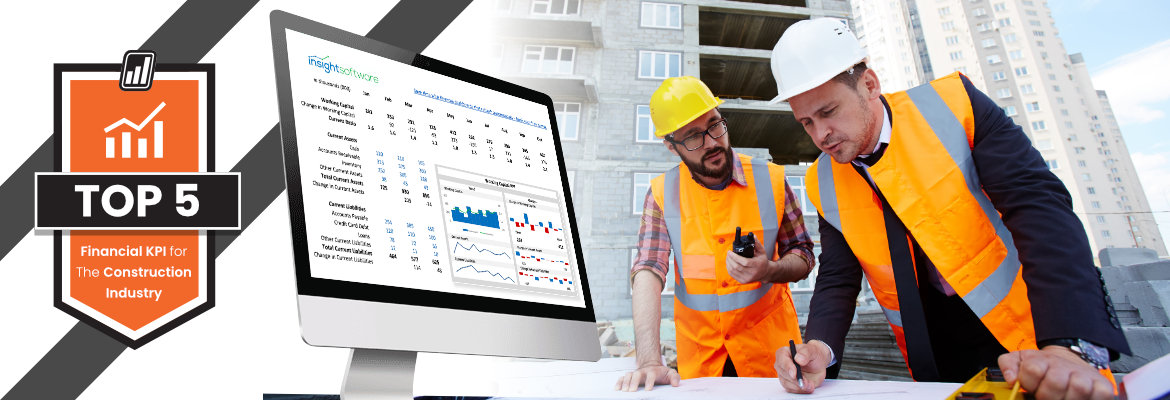
At the start of 2020, construction was projected to grow at 4.5 percent annually through the next several years. Now that every industry is facing a prolonged period of uncertainty, having access to accurate, up-to-date information is more critical than ever. When the economy picks up again, having visibility into staffing levels will be important, as well as understanding where growth can occur. Areas like renewable energy are expected to soar, while others—such as electric utilities—may see a decline.
What Are Construction KPIs?
Construction KPIs (Key Performance Indicators) are specific metrics used to evaluate and monitor the performance of construction projects. These indicators provide essential insights into various aspects of a project, including cost, time management, safety, and quality. By tracking these KPIs, construction firms can ensure that projects are on track, identify potential issues early, and make informed decisions to improve outcomes. KPI construction is critical in helping firms achieve their strategic goals by aligning day-to-day operations with broader business objectives. To effectively manage projects, construction businesses must regularly monitor their KPIs, which is essential for navigating economic uncertainty, as discussed in the importance of tracking KPIs in construction.
Why Are KPI in Construction Important?
KPIs in construction are crucial because they provide a clear and measurable way to assess the progress and success of a project. By using KPIs, construction managers can ensure that projects are completed on time, within budget, and to the required quality standards. These indicators help in identifying inefficiencies, managing risks, and ensuring compliance with safety regulations. For instance, KPIs related to financial reporting can help construction firms mitigate enterprise risk by providing real-time insights into the financial health of a project, as highlighted in real-time financial reporting. The ability to measure and respond to performance metrics is what makes KPIs so valuable in construction.
Benefits of KPI Construction
The benefits of KPI construction are numerous and can significantly impact the success of a construction project. First and foremost, KPIs provide transparency and accountability, allowing project managers to track performance against established benchmarks. This can lead to improved efficiency and cost management, as managers can quickly identify areas where resources are being wasted or where delays are occurring. Additionally, KPIs can enhance decision-making by providing data-driven insights, enabling managers to make informed adjustments to project plans. In the long run, consistently tracking and improving KPIs can lead to better client satisfaction, as projects are more likely to be completed on time and within budget. Furthermore, modernizing job estimation reporting tools, as discussed in modernizing job estimation reporting, can enhance the accuracy of these KPIs, providing even greater benefits.
Examples of Construction KPIs
There are several key construction KPIs that are commonly used to monitor the performance of projects:
Cost Performance Index (CPI): This KPI measures the cost efficiency of a project by comparing the budgeted cost of work performed to the actual cost. It helps managers assess whether a project is within budget.
Schedule Performance Index (SPI): This metric evaluates the efficiency of time management by comparing the planned schedule to the actual progress. It is essential for ensuring that projects stay on track.
Safety Incidents: Tracking the number of safety incidents on-site is crucial for maintaining a safe working environment and ensuring compliance with regulations.
Quality Defects: This KPI monitors the number of defects or rework required, helping to maintain high-quality standards throughout the project.
These examples illustrate the diverse range of KPIs that can be used in construction to ensure successful project outcomes. Tracking these KPIs is particularly important for construction businesses looking to improve their financial reporting accuracy, as discussed in the critical role of fast and accurate financial reporting for construction firms.
Top 5 Construction KPIs
With so much uncertainty on the horizon, everyone in the construction industry needs to be at the top of their game, especially in terms of finance and accounting. It's a big effort, and it requires a clear understanding of financial performance based on the key indicators. Every company will incorporate different KPIs, but all of them will use these five:
Net Income
Measured by taking revenues and subtracting things like taxes and expenses, net income is simply another word for profit. Since earning profit is the sole reason businesses exist, this is a metric that decision-makers need to have on their radar at all times. Following when, why, and to what degree the net income changes over time offers crucial insights into financial performance. Forecasting net income based on past performance can also help senior management plan future decisions around the company's predicted financial strength.
Average Accounts Receivable Aging
Owing to high labor and overhead costs, construction companies need to perfectly understand their cash flow. That takes multiple metrics, including average accounts receivable aging: the average time between submitting an invoice and receiving the payment. Knowing this number suggests how much money will be on hand later, and changes in the age provide advanced warning of looming cash flow issues.

Monthly Overhead Burn Rate
Essentially a measure of your monthly spending, this metric reveals whether you can keep the doors open next month. It's also an important indicator of how you're managing costs and how those costs translate into revenue. People inside and outside finance can learn a lot from this metric, but the reason it's in the top five is that it sends up red flags in advance of a cash flow crisis. For that reason alone, it deserves constant attention.
Bonding Capacity
Though not strictly a financial metric, a company's bonding capacity says a lot about its revenue-generating potential. Companies can't pursue projects that exceed their capacity to secure bonds, which puts a hard cap on how much income they can make. Increasing the bond capacity takes time, so this number might not change a lot, but it still requires ongoing focus because it factors into so many strategic and financial decisions.
Bid Development
Multiple metrics reveal how many bids are in the pipeline: pending bids, business development meetings scheduled, active proposals with win probability, etc. In some form, all construction companies need to be looking forward and estimating future income and expenses. The whole point of tracking financial KPIs is to identify opportunities and obstacles early enough to react accordingly. Some metrics reveal what's happening now or in the near future while others, like bid development, offer a glimpse into the long-term financial health of the company.
How you track metrics is just as important as what you choose to track. With financial reporting tools from insightsoftware, construction companies can effortlessly attend to these metrics, even getting real-time updates. Reporting becomes so easy, in fact, that you can follow a lot more than five metrics. Learn what else you should be tracking by downloading our ebook: Guide to the Right KPIs for the Modern CFO.