
Why You Should Consider a Rolling Forecast

insightsoftware ist der umfassendste Anbieter von Lösungen für den Bereich des Finanzvorstands. Wir verwandeln Informationen in Erkenntnisse und versetzen Führungskräfte damit in die Lage, ihr Unternehmen strategisch voranzutreiben.

In periods of uncertainty, organizations forecast more frequently, hoping that doing so will help them more accurately plan for future trading prospects, levels of activity, and resources needed for the coming months. Yet, all too often, businesses rely on static forecasts to drive insights, failing to realize that their forecasting structure is not mirroring the dynamic economic environment in which they are operating. Increasing the frequency of how often your business forecasts doesn’t necessarily lead to richer or more accurate insights, and instead wastes valuable time
At FSN, we call this process the “hamster wheel” effect. While the forecasting wheel is turning faster and faster, the process hasn’t changed materially, leaving you with the same surface-level insights. A wise CFO will recognize how this dissonance is affecting their business success, and start to look for a solution beyond the traditional forecast model. .
What is a Rolling Forecast?
The primary way finance leaders are navigating the challenges of accurate forecasting is by implementing rolling forecasts. This type of forecast is continuous, meaning that as a given financial period is completed, another period is added, extending for the same amount of time into the future. Creating a realistic rolling forecast often requires a deep understanding of how the business operates, as well as an objective analysis of what factors affect a business at any given point. Although creating a rolling 12-month forecast certainly requires more effort than creating a traditional 12-month forecast, rolling forecasts are often more accurate and attainable because of the deep knowledge that is required to create them.
To better illustrate what a rolling forecast looks like practically, let’s consider an example of a 12-month rolling forecast from January to December. After January has concluded, a rolling forecast will remain 12 months long, recalculating to now include the following month in a 12-month cycle, in this case, being February to January. With a rolling forecast model, your forecast will always span 12 months, adding additional months as previous ones fall off.
Benefits of a Rolling Financial Forecast
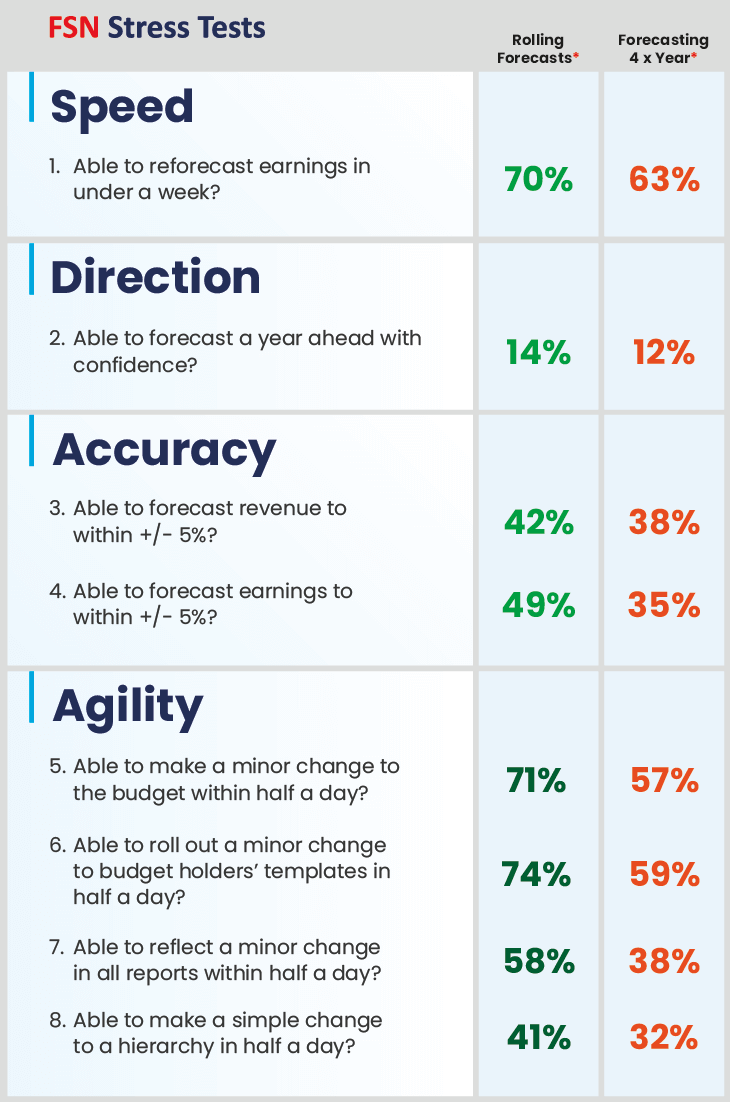
There are numerous benefits to implementing a rolling forecast in your financial planning process. FSN’s 2021 research, “Agility in Planning, Budgeting, and Forecasting,” confirms the profound benefits of a rolling forecast technique. As one would expect, those using a more automated 12-month rolling forecast are able to reforecast more quickly. Seventy percent are able to reforecast in under a week, versus 63% who only reforecast quarterly. Likewise, there is also an improvement in the number of organizations that can forecast a year ahead, specifically 14% versus 12%.
Most impactful to finance leaders, though, rolling forecasts are noted for improving accuracy and flexibility. Almost half of rolling forecasters are accurate to within plus or minus 5% of earnings. This is substantial when considering corporations that forecast four times a year, which are typically within 35% of their forecasted earnings. There is an improvement in revenue forecasting as well, although slightly less marked, 42% versus 38%.
What’s the Difference Between Rolling Forecasts and Static Budgets?
At their core, rolling forecasts and static or annual budgets differ because of the approach that is taken while they are being created. Rolling forecasts are created while trying to be as objective as possible about the future. In contrast, static budgets are built around hypothetical scenarios and company goals, projected into the future.
Created from historical data in preparation for an upcoming fiscal year, budgets are fixed documents that establish a company’s financial plans over a set period of time. Typically, budgets are curated on goals surrounding revenue and profit margins. As the period progresses, the budget is used as a way to compare performance expectations with actual performance. A critical issue arises from this model, though, as budgets quickly become outdated, forcing them to be updated or simply ignored.
Instead of planning according to goals, a rolling forecast is centered on what is likely to happen in the marketplace. Historical data is not the sole resource a forecast is based on, but rather, a base that is considered alongside market shifts, staffing concerns, material availability, customer relationships, and macroeconomic factors. As such, rolling forecasts are both more laborious to set up, as well as more useful in the long run, as they inform more accurate decision-making and are not constrained by the limitations of a financial year.
Rolling Forecast Best Practices
While implementing a rolling forecast certainly sounds ideal, creating an effective rolling forecast necessitates considerable planning and support before it can be used to glean meaningful insights. Here are some best practices to keep in mind if your organization is interested in implementing a monthly rolling forecast:
Establish Objectives Early
Before you incorporate a rolling forecast into your financial process, it is critical that you first establish what your goals for the forecast are and how your team plans to support it. Your forecast may look different depending on whether you want a more accurate picture of the future than if you are focused on properly allocating resources. Additionally, you will need to identify who will be most affected by implementing a rolling forecast. Your stakeholders will include those who will rely on the forecast, as well as those who will need to create and update it.
Determine Guidelines
When setting up your rolling forecasts, your team will have to solidify key parameters that will guide the project. For example, you will need to consider whether the forecast will be company-wide or specialized for each division. You will need to decide how frequently the forecast will be updated; is monthly regular enough for your needs, or would weekly be better? Similarly, should the forecast stick with the traditional model of mapping 12 months into the future, or would a longer timeframe of 18 months be more useful? Once you have answered these questions, it is key to ensure that all stakeholders are also in agreement.
Review Regularly
To ensure your rolling forecast is working properly for your team, it's vital to review results, specifically any abnormalities, regularly. Variances are to be expected if your estimates are not completely accurate at the beginning of the forecasting process, but it is important to correct them once you realize their inaccuracy so as not to compound over time. If the performance abnormality is in fact a true variance, this will be worth investigating as it may lead to valuable insights.
Why Your Business Should Implement a Rolling Forecast for Budgeting
While we’ve previously noted that there is a significant improvement in speed and accuracy amongst organizations that use rolling forecasts, the progress is even more profound within the context of organizational change. Businesses using rolling forecasts are able to make changes far more quickly and easily when circumstances require.
For example, 71% can get a minor change, such as a cost line added or taken out of a budget or forecast model within half a day, versus 57% who are bound to quarterly forecasts. There is a similar disparity in getting changes added to budget holders’ data entry templates; 58% of those using rolling forecasts are able to get the above change reflected in all reports within half a day, whereas only 38% of quarterly reforecasters can do it within the same timeframe. Finally, 41% can make a simple change to their reporting hierarchies in half a day compared with 32% of the quarterly re-forecasters. To say that rolling forecasts allow for added flexibility would be an understatement.
Table 1. Comparison of the performance of organizations using rolling forecasts and those reforecasting four times a year.
*The table shows the percentage of organizations that satisfied each stress test.
JustPerform: Your Business’s Rolling Forecast Solution
Rolling forecasters outperform the quarterly forecasters in every category (see Table 1 above), but despite the profound advantages, uptake has been relatively slow and sparse. Only 19% of organizations have moved to rolling forecasts.
This year’s FSN research shines a light on why uptake has been so low. Around three-quarters of organizations are heavily reliant on standalone spreadsheets, but these are not up to the job. Rolling forecasts require a dependable, centralized repository of data and the financial intelligence (periodicity, automatic period roll-over, multi-dimensionality, calculation support) of specialized planning, budgeting, and forecasting solutions. These things are not easily replicated in a spreadsheet.
To truly implement a rolling forecast, you’re going to require dependable software that integrates directly with your ERP to pull in live financial and operational data. With insightsoftware’s JustPerform, your forecast model will always work off the latest actuals and key business drivers, ensuring your rolling forecast reflects business realities rather than outdated spreadsheet figures. JustPerform allows you to automate assumptions and projections in a given time frame, meaning your forecast can continue extending into the future, always there for crucial business decisions when you need it.