
Tax Planning Software for Accountants: How Tax Professionals Can Make Their Planning More Strategic in 2026

insightsoftware is the most comprehensive provider of solutions for the Office of the CFO. We turn information into insights, empowering business leaders to strategically drive their organization.

The function that tax teams serve is rapidly evolving into a more strategic role within modern organizations. However, given this pace of change, many executives are still unaware of the untapped strategic potential within their tax teams. This is an unfortunate reality that many tax technologists and strategists report to us and their peers. In their words, they’re all too often seen as “compliant paper pushers,” and their departments are viewed as mere cost centers or a group of technicians rather than value-adding assets.
On the contrary, tax teams often play an important strategic role. However, this requires them to take a proactive approach in carving out a meaningful position within the company, routinely adding value, and articulating that value to executive management and others throughout the company.
Watch this video first: Tax Reporting in a Changing World
Tax Teams Are Stepping into a More Strategic Role
If tax teams are viewed as mere cost centers, it can be difficult for them to secure executive backing for strategic projects. For example, better software can be a keystone investment for tax teams aiming to reach higher and achieve more. Without that executive sponsorship, a tax team won’t have access to the right tools, meaning they won’t be able to fulfill their strategic function effectively. This, in turn, creates a cost-center mentality that perpetuates the image of the tax team as a collection of paper-pushers. Unfortunately, the result is that it becomes even less likely that they’ll achieve the strategic focus and recognition necessary to secure investment.
See how insightsoftware is helping tax teams with our tax resource center.
How can tax teams break out of this cycle?
During a webinar held by insightsoftware, we heard this general sentiment reported again. We asked attendees to tell us how they felt their tax department is viewed internally by their coworkers. 45% reported being seen as merely reactive or compliant within their organizations — a far cry from the well-valued stature that other tax teams are able to achieve when provided with the right tools.
The best way for tax teams to become more strategic and break this cycle is by first mapping out the operational limitations that force them to only focus on compliance. After these roadblocks are identified, it’s easier to explain what can be done with better support and tools. For example, Longview Tax enables tax professionals to automate many of the reporting processes that currently drain most of their time. With these considerable time savings, they can dedicate more time to mapping out different scenarios with actual and forecasted finance data to make their own strategic suggestions from a tax perspective.
These arguments have already been made and won in many organizations. In fact, within the same webinar mentioned earlier, 67% of attendees reported that they faced particular strategic barriers within the realm of tax and finance forecasting. When an organization struggles with its strategic forecasts, it only makes sense for the tax team to push for executive backing for a solution that boosts these capabilities.
What’s important to note is that the tax team’s work often hinges on the quality and timeliness of the finance data that underpins their forecasts. Better integration with finance systems/ERPs, finding ways to improve the consolidation process, or increasing the granularity of the data available to work with provides both the finance and tax teams with enhanced collaborative capabilities based on high-quality, accurate data.
Tighter collaboration between tax and finance teams inevitably leads to better forecasts and far more opportunities to recognize the invaluable strategic impact that both teams can truly have on their organizations.
Learn how to take your tax department from cost-center to a strategic partner with this webinar.
BEPS Pillar 2 & a Re-Making of Global Taxation
As the approach to global taxation has shifted, tax teams have an even more focused role to play in setting strategic priorities for the organizations they serve. BEPS (Base Erosion and Profit Shifting) is a set of rules and standards established by the Organization for Economic Co-operation and Development (OECD) to overhaul global taxation.
BEPS encompasses two so-called “pillars.” Pillar 1 focuses on very large organizations, but Pillar 2 is much broader and sets a minimum baseline for corporate taxation so multinational businesses are no longer incentivized to shift profits from higher tax countries to low-tax nations.
This has resulted in significant changes to tax reporting. The OECD described BEPS Pillar 2 as “a radical shift in the tax landscape,” and that has proven to be true. Companies need to be on top of new systems and processes like BEPS Pillar 2, and our advanced tax reporting solutions help facilitate this agility and readiness with dynamic planning and intuitive tools to help teams stay ahead of the curve.
See how Longview Tax supports BEPS Pillar 2 tax provisioning here.
insightsoftware Infographic: How Tax Professionals Can Leverage Software to Become More Strategic
For a visual breakdown of the learnings and data from our polls, check out the infographic below or contact us to learn more.
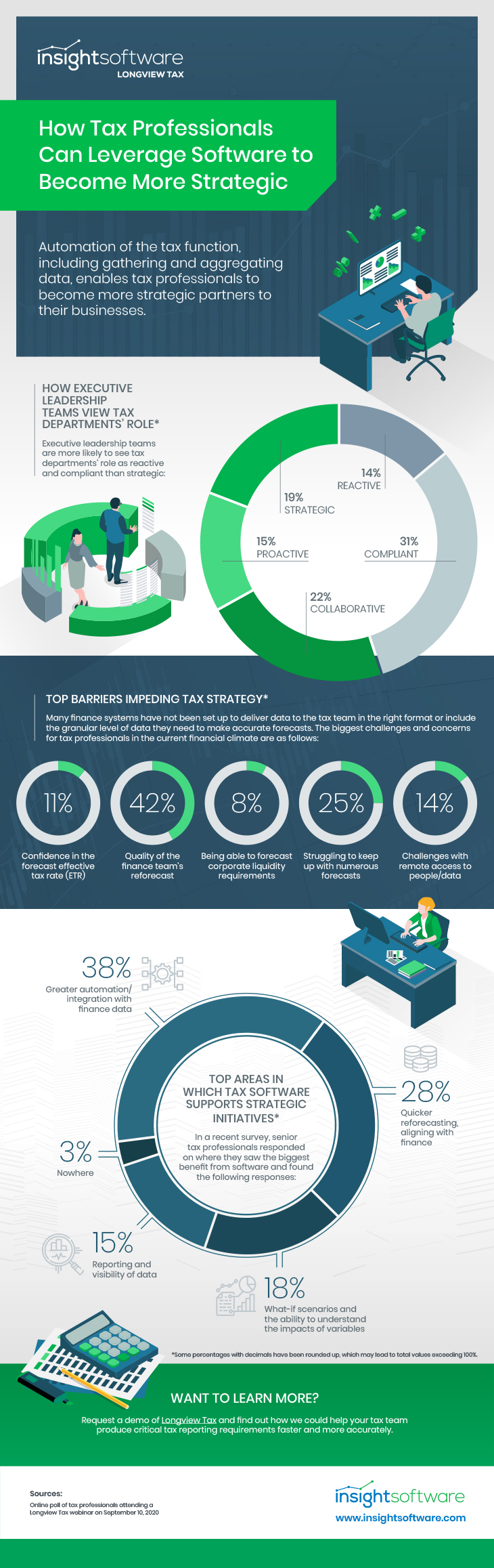
Infographic description: 45% of executive leadership teams view tax departments’ role as reactive (14%) or compliant (31%) compared to 34% that see it as strategic (19%) or proactive (15%). The biggest barriers that impede tax strategy are the quality of finance teams’ reforecast, struggling to keep up with numerous forecasts, and challenges with remote access to people/data. The top areas where tax software (like Longview Tax) supports strategic initiatives are greater automation/integration with finance data (38%), quicker reforecasting and aligning with finance (28%), and what-if scenario modeling to understand the impact of variables (18%). Want to learn more? Request a demo of Longview Tax to see how it can help your tax team create critical tax reports faster and more accurately.
Challenges Open the Door for Opportunities
However, the key takeaway from these conversations and feedback from tax teams is that these challenges also create opportunities. As the world demands greater business agility and as BEPS continues to shift the tax landscape, tax departments have a powerful case for change (perhaps more compelling than ever before). With the right tools, tax teams can address these challenges head-on. At the same time, they gain the assets they need to shift their position in their respective organizations from tactical and reactive to strategic and proactive.
In many companies, for example, manual processes consume far too much time and energy. By investing in the right tax and reporting software, those activities can be automated. Tax teams that spend less time on procedure have more time to spend on strategic analysis. They can also increase the cadence at which they evaluate the company’s positions, making the organization more responsive to a shifting business environment.
How Longview Tax Empowers Tax Teams to be More Strategic
Our Longview Tax platform enables tax professionals to automate many of these reporting processes mentioned above that consume much of their time. The same tool that provides significant time savings also helps them map out different scenarios with actual and forecasted finance data to make their own strategic suggestions from a tax perspective.
As we discussed, the tax team’s work often hinges on the quality and timeliness of the finance data underpinning their forecasts. Tools that can integrate and operate more closely with your existing finance systems can streamline the consolidation process and even increase the granularity of the data. More timely, accurate data leads to better forecasts and far more opportunities to recognize the invaluable strategic impact that tax teams can have on their organizations. Ready to get started? Request a demo of Longview Tax using the form below.
Get a Demo
See how companies are making tax a strategic function while cutting their close timing by 50% in their first year using Longview.